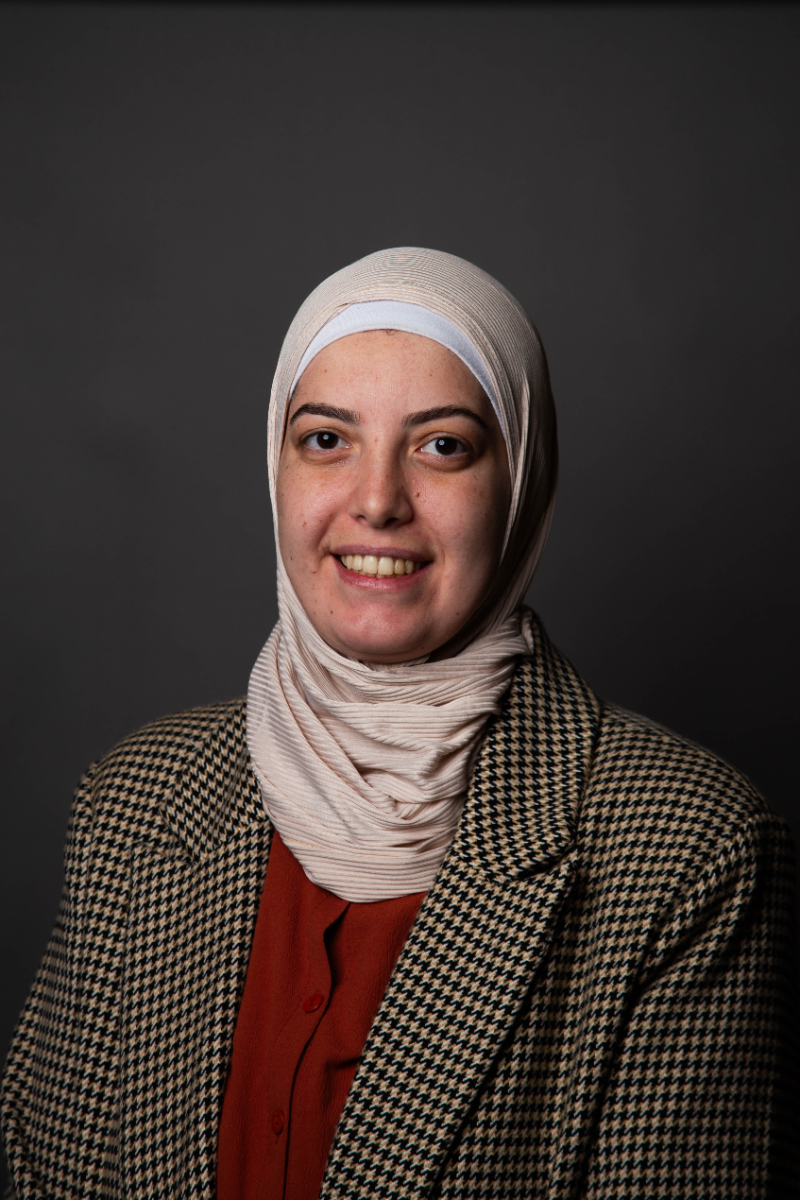
Afra, Kamar

Kamar Afra
PhD Candidate | Biological Anthropology
Kamar (pronounced Amar) is from Beirut, Lebanon. She completed her Bachelor’s degree in Forensic Science in 2016, at the American University of Science and Technology, Lebanon. In 2017 she completed her MA in Anthropology at Texas State University, San Marcos. During and after her Bachelor’s degree, Kamar worked with Act for the Disappeared as a volunteer interviewer, member of the training team, and forensic research assistant. ACT is an NGO based in Beirut that deals with cases of missing persons from the Lebanese civil war. She also worked with the Directory of Antiquity on various archaeological sites in Beirut. As an assistant archaeologist/ bioanthropologist, Kamar worked on documenting and mapping graves, artifacts, and human remains from different historical periods. During her time in Texas, she volunteered at the Forensic Anthropology Center at Texas State University (FACTS) doing skeletal processing, remains recovery, and skeletal inventory. Through the FACTS, she assisted with short courses, gave lectures, and volunteered with Operation identification (OpID). OpID is “a service-learning project founded at the FACTS to facilitate the identification and repatriation of unidentified human remains found along or in close proximity to the South Texas border.”1
During her MA program Kamar was the Graduate Research Assistant (GRA) responsible for curation and inventory of the paleopathology collection at Texas State University. Currently, she is a Graduate Teaching Assistant (GTA) in the UTK Biology Department and volunteers at the Forensic Anthropology Center (FAC).
1https://www.txstate.edu/anthropology/facts/outreach/opid.html
.
Chair: Dr. Graciela Cabana
.
Research
Kamar’s dissertation research evaluates process of disappearance through a biocultural lens. She will explore the different current forensic techniques involved in the process of human identification in the criminal justice system through a community engaged project highlighting local resources.
Kamar is also interested in Islamic mortuary practices and their effects on postmortem decomposition, Quantitative & Statistical Methods through machine learning, and transitional justice in human rights issues.
Awards and Recognitions
2022 F. Stanley Lusby & John O. Hodges Teaching Award, UTK
2022 Simon Beckett Student Paper Prize, FAC, UTK
2020 21st Annual FSF Emerging Forensic Scientist Award, AAFS
2019 Tennessee Fellowships for Graduate Excellence, UTK
2018 Thesis Research Support Fellowship, Txstate
2018 Grady Early Endowment Fellowship, Txstate
2017-2019 Fulbright Scholarship, U.S. Department of State’s Bureau of Educational and Cultural Affairs (ECA)
2017-2019 The Anthropology Graduate Student Scholarship Award, Txstate
2017-2019 Biological Anthropology Award, Txstate
Publications
Afra, K., Algee-Hewitt, B. F., & Hamilton, M. D. (2021). Understanding the Relationship between Genetic Markers and Skeletal Remains: Implications for Forensic Anthropology and Phenotype-Genotype Studies. Human Biology, 93(2), 83-104.
Afra, K., Hamilton, M. D., & Algee-Hewitt, B. F. (2021). Self-reported ancestry and craniofacial SNPs: Assessing correspondence with implications for forensic case analysis and reporting. Forensic Anthropology, 4(4), 181.
Education
MA Anthropology; emphasis on Biological Anthropology, Texas State University, San Marcos, Texas, USA, 2019
Master’s Thesis: Genotypic expression of traits on craniofacial hard tissue for positive identification purposes in a modern European-American skeletal collectionBS Clinical Laboratory Science; emphasis on Forensic Science, American University of Science and Technology, Beirut, Lebanon, 2016