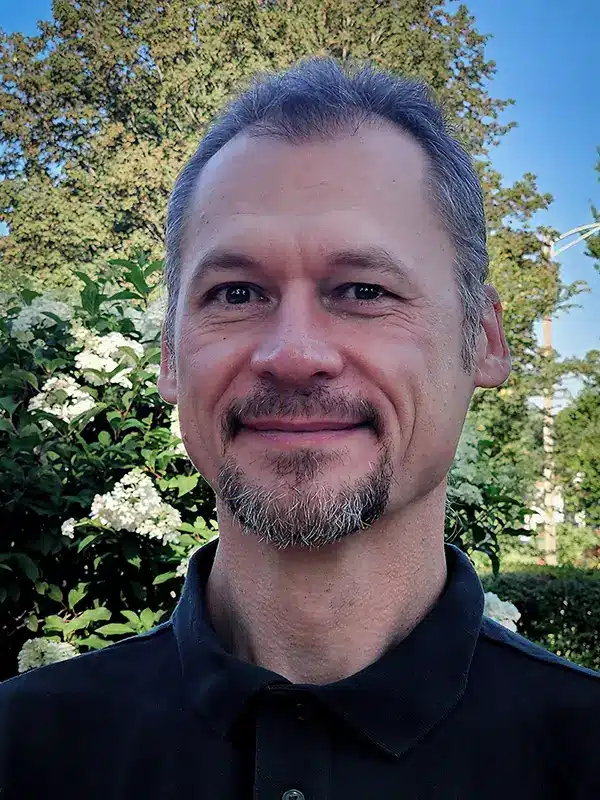
Hubbe, Mark

Mark Hubbe
Professor & Department Head | Biological Anthropology
Mark Hubbe’s research program draws from a strong quantitative and evolutionary framework and is structured around wide interdisciplinary collaborative networks with colleagues and students from the US, Brazil, Chile, Mexico, and Germany. His work spans a broad range of topics, including the early peopling of South America, the evolution of cranial morphology within the genus Homo, and the study of frailty and stress in past populations.
Currently, Hubbe is focused on a critical review of our discipline, aimed at refining theoretical and methodological assumptions in the field, with special attention to how we incorporate lived experiences and accumulated stress into interpretations of the past. This new research line has inspired his current NSF-funded project, which began in 2024. The project explores the value of using epigenetic clock markers to estimate chronological age at death from human skeletal remains and evaluates the impact of accumulated physiological stress on these age estimates.
In the last three years, Hubbe has applied his expertise in evolutionary quantitative methods and cranial morphological variation to investigate the evolutionary processes that shaped the genus Homo during the Pleistocene. This work, conducted in collaboration with Dr. Harvati (University of Tübingen), tests hypotheses about the influence of cultural practices as factors that reduced selective pressures on cranial morphology, facilitating the divergent evolution of the human lineage.
Beyond his main research foci, Hubbe maintains a highly interdisciplinary record within and outside Anthropology, having collaborated on research projects and publications across multiple disciplines, including Human Biology, Cultural Anthropology, Archaeology, Geology, Paleontology, and Zoology.