• Request Info
  • Visit
  • Apply
  • Give
  • Request Info
  • Visit
  • Apply
  • Give

Search

A-Z Index Map

Anthropology

  • About
    • Governance
    • Giving
    • Request More Info
    • Forensic Anthropology Center
  • People
    • Faculty
    • Affiliated Faculty
    • Staff
    • Graduate Students
    • Emeritus
    • In Memoriam
  • Areas of Study
    • Anthropological Archaeology
    • Biological Anthropology
    • Cultural Anthropology
    • Disasters, Displacement, & Human Rights
  • Undergraduate
    • Majors & Minors
    • Advising
    • Careers
    • Departmental Scholarships
    • Undergraduate Anthropology Association
    • Course Descriptions
    • Apply
  • Graduate
    • Degree Programs
    • Apply
    • DDHR Graduate Certificate
    • Graduate Handbook
    • Graduate Forms
    • Awards & Grants
    • Graduate Student Association
  • Opportunities
    • Lab Facilities
    • Field Schools
    • DDHR Working Paper Series
  • News & Events
    • Visiting Lecture Series
    • DDHR Webinar Series
    • Newsletters
    • Share Your News
topography background

News

Uncategorized

Alex Bentley headshot photo

Alex Bentley in ‘The Conversation:’ Will AI accelerate or undermine the way humans have always innovated?

Alex Bentley in ‘The Conversation:’ Will AI accelerate or undermine the way humans have always innovated?

R. Alexander Bentley, University of Tennessee

In graduate school, my experimental archaeology professor told a student to create a door socket – the hole in a door frame that a bolt slides into – in a slab of sandstone by pecking at it with a rounded stone. After a couple of weeks, the student presented his results to the class. “I pecked the sandstone about 10,000 times,” he said, “and then it broke.”

This kind of experience is known as individual learning. It works through trial and error, with lots of each. Also known as reinforcement learning, it is how children, chimpanzees, crows and AI often learn to do something on their own, such as making a simple tool or solving a puzzle.

But individual learning has limits. No matter how much someone experiments through trial and error, improvement eventually hits a ceiling. Humans have been throwing javelins for a few hundred thousand years, yet performance has largely plateaued. At the 2024 Olympics in Paris, the gold medal javelin throw was about 5% shy of Jan Železný’s 1996 record. The level of expert play in the strategy game Go was essentially flat from 1950 to 2016, when artificial intelligence changed the equation.

Throughout humanity’s existence, these limits on individual learning have not applied to technology. Since IBM’s Deep Blue defeated world chess champion Garry Kasparov in 1997, supercomputers have become a million times faster – and now routinely outperform humans in chess and many other domains.

Why is technological improvement so different? My work as an anthropologist on cultural evolution and innovation shows that, unlike individual performance, technology advances through combination and collaboration. As more people and ideas connect, the number of possible combinations grows superlinearly. Technological innovation scales with the number of collaborators.

My new book with anthropologist Michael J. O’Brien, “Collaborators Through Time,” reveals these patterns across human existence. It traces how 2 million years of technological traditions progressed through collaboration among specialists, across generations and with other species.

Expertise has been the key. Because traditional communities know who their experts are, specialization and collaboration have consistently underpinned human success as a species.

I’d summarize our insight into how technology keeps advancing as TECH: tradition, expertise, collaboration and humanity.

Acheulean hand axes are one of the earliest technologies humans developed. Didier Descouens/Wikimedia Commons, CC BY-SA

Traditions and expertise – the critical foundation

The longest technological tradition documented by paleoanthropologists was the Acheulean hand axe. The multipurpose stone tool was made by our hominin ancestors for almost a million years, including some 700,000 years at a single site in eastern Africa. People produced Acheulean tools through techniques they learned, practiced and refined across generations.

Later, small prehistoric societies of modern humans thrived on millennia of specialized knowledge, such as music, thatched roofs, seed cultivation, burying dead bodies in bogs, and making millet noodles and even cheese suitable for interring with mummies.

As early as 22,000 years ago, communities near the Sea of Galilee stored and used more than a hundred plant species, including medicinal plants. Shamans – ritual experts in medicinal knowledge and caregiving – helped their groups survive. Archaeological evidence from burial sites suggests these specialists were widely revered across thousands of years: One shaman woman was interred with tortoise shells, the wing of a golden eagle and a severed human foot in a cave in Israel.

Collaboration – knowledge spanning time and place

Traditional expertise alone does not advance technology. Technological progress occurs when different forms of expertise are combined.

The wheel may have emerged from copper-mining communities. One expert sourced copper from the Balkans, another transported it, another smelted it. By about 4000 B.C., additional specialists cast copper into an early wheel-shaped amulet: shaping a wax model, encasing it in clay, firing it in a kiln, pouring molten metal into the mold, then breaking the mold away.

Transport technologies reshaped ancient product networks. As communities across Eurasia and Africa built wheeled vehicles and ships, and raised domesticated horses and other pack animals, collaboration expanded across continents. Maritime and overland trade linked blacksmiths, scribes, religious scholars, bead makers, silk weavers and tattoo artists.

Expertise was often distributed between cities and their hinterlands, with cities functioning as hubs in cross-continental product networks. In ancient Egypt, no single community could produce a mummy. Mummification experts at Saqqara drew on a continental network that supplied oils, tars and resins, combining these materials with specialized techniques of antisepsis, embalming, wrapping and coffin sealing.

ancient Egyptian image of a human figure with a dog head
Anubis, god of mummification and the afterlife, depicted in a mummification setting. Mummification materials were sourced from across the continent. André/Wikimedia Commons, CC BY-SA

Around the world, states and empires – from the Indus Valley Civilization to the Vikings, Mongols, Mississippians and Incas – expanded these networks, serving as hubs that coordinated the exchange of raw materials, specialized knowledge and finished products. These exchanges could be highly specific: Chinese porcelain was shipped exclusively to 12th-century palaces in Islamic Spain via Middle Eastern traders who added Arabic inscriptions in gold leaf.

The scale has changed, but the structure has not. Today, within a global product space, an iPhone is assembled from a distributed network of specialized expertise and facilities.

Humanity – social learning

Today, AI may disrupt the millennia-long pattern of technological advancement through TECH. Most large language models generate statistically common responses, which can flatten culture and dilute expertise and originality. The risk grows as untapped high-quality training data – our reservoir of expertise – becomes scarcer.

This creates a feedback loop: Models trained heavily on low-quality content may degrade over time, with measurable declines in reasoning and comprehension. Some scientists now warn that humans and large language models could become locked in a mutually reinforcing cycle of recycled, generic content, with brain rot for everyone involved. The dystopian extreme is AI model collapse, in which systems trained heavily on their own output begin to produce nonsense.

Brain rot is one reason some AI pioneers now question whether large language models will achieve human-level intelligence. But that, I think, is the wrong focus. The key to continually improving AI models is the same one that has sustained human expertise for millennia: keeping human experts in the loop – the E in TECH. Thanks to a kind of “pied piper” effect, an informed minority can guide an uninformed majority who copy their neighbors.

In a classic experiment, guppies, following their neighbors, ended up schooling behind a robotic fish that guided them toward food. A recent study showed that traffic congestion eases when autonomous vehicles make up as little as 5% of cars on the road. In both cases, a small, informed minority reshaped the behavior of the whole system.

Like humans, large language models are social learners, and the learning can go in either direction. Designers can increase the likelihood that models continue to improve by ensuring they incorporate the accumulated lessons of human expertise across history. In turn, this creates the conditions for people and models to learn from one another.

In the 2010s, DeepMind’s AlphaGo rediscovered centuries of accumulated human Go knowledge through individual learning, then went beyond it by crafting strategies no human had ever played. Human Go masters subsequently adopted these AI-generated strategies into their own play.

Well-trained large language models can likewise summarize vast bodies of scientific information, help talk people out of conspiracy thinking and even support collaboration itself by helping diverse groups find consensus. In these cases, the learning flows both ways.

From Acheulean hand axes to supercomputers, human innovation has always depended on tradition, expertise, collaboration and humanity. If AI is tuned to find and trust expertise rather than dilute it, it can become humanity’s next great technology – on par with ancient writing, markets and early governments – in our long story as collaborators through time.The Conversation

R. Alexander Bentley, Professor of Anthropology, University of Tennessee

This article is republished from The Conversation under a Creative Commons license. Read the original article.

Posted: March 4, 2026Filed Under: Featured, News, Uncategorized

Raja Swamy

DDHR Program Working Papers Series

Raja Swamy

The Disasters, Displacement, and Human Rights (DDHR) Program is now accepting submissions to a new working papers series. Envisioned primarily as a vehicle for UT graduate students and faculty to share their academic work as it is being prepared for final publication, the series is the brainchild of Raja Swamy, assistant professor of anthropology. It will provide an opportunity for authors to receive feedback on their work and to disseminate it widely to an audience of scholars interested in themes relating to disasters, displacement, structural violence, human rights, and social justice.

When pandemic travel and gathering restrictions are lifted, the series will become an important part of the biennial DDHR conference, enabling conference attendees to develop papers for formal publication.

Visit the Submissions Portal


Posted: January 20, 2021Filed Under: DDHR-News, News, Uncategorized

Understanding Foodways

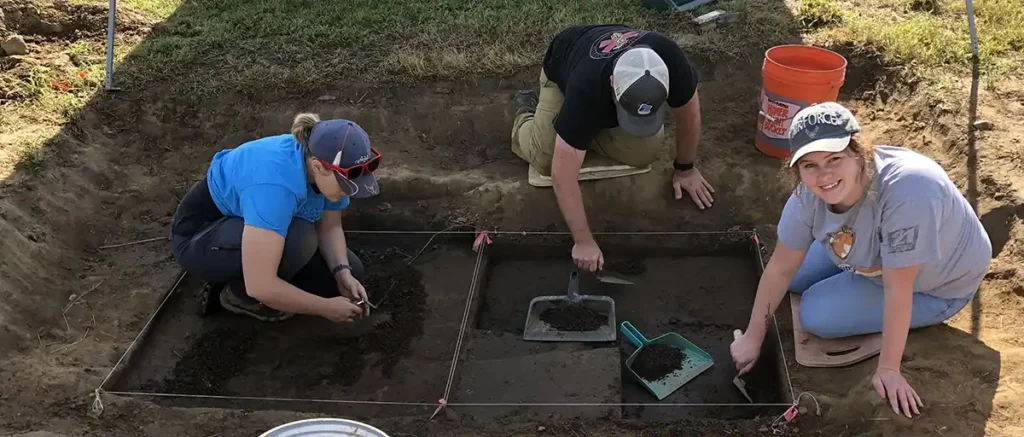
a group of Anthropology students at Excavations at Cherokee Farm
Excavations at Cherokee Farm

Kandace Hollenbach, assistant professor, is working with undergraduate major Hattie Ruleman on her senior honor’s thesis, which focuses on extracting, identifying, and analyzing carbonized plant remains from samples excavated from roughly 2,500-year-old archaeological deposits at UT’s Cherokee Farm campus. Hollenbach taught a field school at Cherokee Farm during the 2018 and 2019 May mini-terms. The project is part of her larger research effort to understand the transition from foraging (gathering) to farming in the Midsouth region, which includes East Tennessee.

Kandace Hollenbach
Kandace Hollenbach

Hollenbach specializes in paleoethnobotany, the study of ancient plant remains. Her work sheds light on the foodways of past peoples, which include the ways people procure, produce, process, cook, share, consume, store, and discard foods. These practices are tied to social and ecological opportunities and constraints. Understanding foodways helps to clarify the relationships of people within and between households, with neighbors, and with plants, animals, and other resources in the landscape.

Approximately 4,000 years ago, people in the Midsouth stopped relying solely on wild fruits, seeds, and nuts foraged from floodplains and upland forests. They began cultivating a suite of plants and domesticated at least five of them, including squash, sunflower, and chenopod (a northern cousin of quinoa). During this transition, peoples’ relationships with the landscape, and their mobility, also shifted, as early farmers invested resources in cultivated plots. By about 3,000 years ago, their increased investment led to a more sedentary lifestyle and changing relationships with neighbors, who no longer had access to (at least some) plants growing in those plots. The deposits at Cherokee Farm are related to these increased investments in floodplain cultivation.

Hattie Ruleman

In her work, Ruleman has identified chenopod and maygrass seeds in the samples, in addition to hickory nuts, acorns, and grape seeds. Later deposits, dating to about 800 years ago, indicate a shift to maize farming and use of wild rice.

In modern foraging groups around the world, women are the primary gatherers, and this was probably true in the past. Hollenbach’s research places the decisions of past women at the forefront of her research. Among early foragers, women may have decided when to move camp to take advantage of ripening fruits, seeds, and/or nuts at particular places on the landscape. Given their roles as gatherers, women likely became the first farmers in the eastern United States. The transition from foraging to farming likely led to changing relationships between women and men.

Despite these important shifts in how groups interacted with the landscape, their neighbors, and within their households, few archaeologists have examined the consequences of the shift to farming in the Midsouth. Hollenbach’s work with Ruleman and other students is helping to change our understanding of the social and ecological consequences of the transition from foraging to farming.


Posted: January 20, 2021Filed Under: Uncategorized

Barbara Heath

Working Together

Barbara Heath

Message from the Department Head

I began my new position as department head in August, having served on the faculty since 2006. I am grateful for all of the support and encouragement that my colleagues have shared during what has been a challenging year for faculty, staff, and students at UT and across the country.

With the outbreak of COVID-19 in March, UT moved all courses online in the space of a week, implemented travel restrictions, curtailed access to campus labs, the libraries, and other on-campus spaces, cancelled graduation ceremonies, off-campus summer programs and in-person interviews, and began to create the infrastructure for combatting the spread of the disease within our community. These changes, although necessary and prudent, have had a profound effect on research, teaching, and learning. By fall, the department had been transformed both physically and psychically. Staff, with the help of an ad-hoc group of faculty, moved furniture in classrooms and hallways into temporary storage to accommodate social distancing requirements, posted signage, and purchased and distributed PPE; instructors pioneered new classroom technologies that allow us to teach more effectively in this new pandemic world; and we collectively reached out to undergraduate and graduate students to find out how they were coping and what they needed to succeed.

Despite being physically distant, in some ways this year the department has become a more cooperative and caring place, facing head-on not only the coronavirus pandemic, but the need for each of us to work together to address the social pandemic of racism and to strengthen the department as an equitable learning community based on respect. The recent losses of our colleagues Rebecca Klenk, a cultural anthropologist, and Randy Pearce, a dentist and forensic odontologist, have also brought many of us together to mourn their passing.

Even in the midst of these extraordinary challenges, we continue our mission of research, teaching, and service. The department is undergoing a period of rapid growth. The addition of undergraduate concentrations in forensics and disasters, displacement, and human rights (DDHR), coupled with broader societal factors that underscore the relevance of anthropological knowledge in today’s world, have resulted in an impressive 47.5% increase in majors over the last two years. Growing numbers of students are also taking advantage of the DDHR graduate certificate.

Members of the department continue to shine as award-winning educators and nationally and internationally-recognized student achievers, leaders within the profession, and recipients of prestigious research grants. I have summarized many of our accomplishments below, and others appear in greater detail in the online version of the newsletter, but I would like to take this opportunity to highlight just a few.

  • Professor Dawnie Steadman was named a Chancellor’s Professor, the highest lifetime honor that can be accorded to a member of the faculty, which recognizes extraordinary scholarly accomplishment as well as a record of excellence in teaching and service to the university. She also received the Dr. William M. Bass Professorship in the Department of Anthropology and the Forensic Anthropology Center, established through a generous donation by Joseph M. and Rebecca H. Haskins. The award is based on excellence in research and teaching in the field of forensic anthropology.
  • Associate Professor Ben Auerbach’s co-edited volume, The Evolutionary Biology of the Human Pelvis: An Integrative Approach, was published by Cambridge University Press.
  • Professor Alex Bentley, Associate Professors Garriy Shteynberg (psychology), and Jonathan Garthoff (philosophy), received the College of Arts and Sciences Award for Interdisciplinary Collaborative Scholarship and Research in 2019 for their work on collective learning and its impact on collective identities, social norms, and strategic cooperation.
  • Hera Jay Brown (’18) was named a 2020 Rhodes Scholar.
  • Clare Remy was one of five UT undergraduate students to receive a prestigious Goldwater Scholarship.

Looking ahead, 2022 will mark the department’s 75th anniversary and the 50th anniversary of granting graduate degrees. Soon we will begin planning ways to celebrate these important milestones. If you have stories that you would like to share of your time at UT, I would love to hear from you. I look forward to welcoming you back to campus post-pandemic. Until then, please stay safe and well.

Barbara Heath
Professor and Head
Department of Anthropology


Posted: January 20, 2021Filed Under: News, Uncategorized

Remembering Dr. Rebecca Klenk

Obituary from The Daily Times


Rebecca Klenk died of pancreatic cancer, peacefully at home in Maryville, Tennessee, at the foot of the Smoky Mountains, on November 15th, 2020. Becca was born in Boston and grew up mostly in New York – Riverdale, Chappaqua, Ardsley, and out in the countryside near Cooperstown – with a two-year stint as a preschooler in New Orleans. She was happiest outdoors and in the company of horses, dogs, cats, and her three siblings. After an early childhood living in cities and towns, during her teenage years Becca became a country girl. Horses were a special passion in those days; Becca was never more at ease than when roaming through the hills and woods on her own, carried by a favorite horse. She also loved to write – just for herself, not for teachers – especially about riding horses in the woods. She graduated from Cooperstown Central Junior-Senior High School in 1981, an able but not especially enthusiastic student, and followed her family’s move to Colorado, where she attended Colorado College (her college application essay narrated the pleasure of riding horses in the woods). Having chosen Colorado College primarily for its proximity to the Rocky Mountains and fully expecting to spend far more time hiking than studying, it was actually in the context of the rigorous liberal arts curriculum there that Becca discovered her intellectualism and capacity as a scholar. She graduated in 1985 with a BA in Anthropology, a love of writing, and keen interests in critical theory, poverty, and environmental degradation in the US and abroad. Not ready for graduate school, Becca spent three years traveling, working as a physical therapy assistant in a Denver hospital, as a fisheries biologist aboard boats in the Bering Sea, and as a deckhand on fishing scows off the coast of Yakobi Island, Alaska. This time shaped her plan to continue studies in Anthropology at the University of Washington. Becca was ready to take up all school had to offer – she worked as a research assistant for a paleoethnobotanist and two medical anthropologists, learned Hindi, dove into challenging theoretical texts, and prepared for fieldwork in rural Himalayan India, where she planned to study village women’s social justice activism to control local forest resources. After almost a decade of study, fieldwork, writing, and teaching, Becca completed a doctorate in Anthropology in 1999, her life transformed, especially by relationships formed during more than two years spent living in a rural Himalayan village.

Just as she was finishing her dissertation, life blew in yet another new direction: a move to small-town Appalachia, a new mountain range to explore and a new Tennessee home, a move for love. There Becca shaped an offer to adjunct a course at the University of Tennessee into much more, learned that she loved to teach, continued to love writing, and with her husband Dan Klingensmith raised their beautiful son, Aaron. Together with Dan, she did the usual stuff of academic life: wrote a book and articles about research in India, prepared classes, mentored twenty-somethings, wrote grant applications, presented conference papers, dealt with exquisitely petty politics. But she also returned with her family to India for further research in 2007 and 2014, and she returned on her own in 2009 and 2015. She regularly offered courses on Gender and Globalization, South Asia, an introduction to race, an introduction to Global Studies, Women, Politics and the Law and others. Two favorites were a course on Bollywood cinema and one on the cultural anthropology of mountain environments. After a rich life lived in many places, with dear ones spread across the globe, in the end, it was Maryville, Tennessee that became Becca’s home; she loved the big old trees in her back yard, the small garden of herbs, flowers and vegetables that she tended with Dan, long walks in the local park with dog and human friends and ventures up into the Smoky Mountains for longer hikes.

In her last months, she was never happier than with Aaron, Dan, and their canine and feline companions cozily settled into their house for an evening in each other’s company. Becca’s loss is deeply felt by her son Aaron Klingensmith, her husband Daniel Klingensmith, mother Anne Stribling Klenk, sisters Sarah Hanson and Melissa Klenk, brother Chris Klenk, mother-in-law Betty Klingensmith, brothers- and sisters-in-law Craig Hanson, Sally Hoff, William Hoff, Charles Klingensmith, Satoko Klingensmith, John Klingensmith, Erin Fraher, Mary Klingensmith and Doug Hanto; nephews and nieces Dylan Hanson, Parker Hanson, Will Hoff, Britt Hoff, Susan Hoff, Margaret Hopkins, Adam Hopkins, Anna Klingensmith, Sara Maeve Klingensmith, Tucker Hall and Tenley Hall, her godmother Mary Mather, her godson Paul Kiefer, cousins Annie Armistead and Sarah Meltzoff, and many other cousins and grand-nephews and nieces, and many, many wonderful friends scattered over the country and the world. She is predeceased by her father, Eugene L. Klenk, and her father-in-law, Walter Klingensmith. Aaron and Dan would like to thank their family and friends for their support, and also the wonderful staff of the UT Hospice Services program. Due to the COVID pandemic, a memorial service will be held remotely. In lieu of flowers, her family suggests gifts to the University of Tennessee’s program in Disaster, Displacement and Human Rights. You may give securely online at giving.utk.edu, or mail checks payable to UT Foundation/DDHR to 1525 University Avenue, Knoxville, TN 37921. (Please note on any check or online that the gift is in memory of Rebecca Klenk.) Smith Funeral & Cremation Service, Maryville, 865-983-1000, www.SmithFuneralandCremation.com


Posted: November 18, 2020Filed Under: Uncategorized

Recent Posts

  • Alex Bentley in ‘The Conversation:’ Will AI accelerate or undermine the way humans have always innovated?
  • Scholar Spotlight: Yangseung Jeong
  • Steven Lautzenheiser in ‘The Conversation:’ Why can’t I wiggle my toes one at a time, like my fingers?
  • Student-Faculty Collaboration Refreshes McClung Exhibit
  • UT Scholar Part of Rare Etruscan Tomb Discovery

Recent Comments

No comments to show.

Exploring the human experience.

Careers

Newsletter

Giving

Anthropology

College of Arts and Sciences

502 Strong Hall
1621 Cumberland Avenue
Knoxville, TN 37996-1525
+1 (865) 974-4408
anthropology@utk.edu


Facebook Icon    X Icon    Instagram Icon    YouTube Icon

The University of Tennessee, Knoxville
Knoxville, Tennessee 37996
865-974-1000

The flagship campus of the University of Tennessee System and partner in the Tennessee Transfer Pathway.

ADA Privacy Safety Title IX