


The Conversation: ‘Russia’s invasion united different parts of Ukraine against a common enemy – 3 years on, that unanimity still holds’

When Russia invaded Ukraine in the spring of 2022, President Vladimir Putin incorrectly assumed it would be a swift takeover.
In fact, three years on, negotiators from both countries are tentatively exploring the idea of a negotiated way out of a largely stalemated conflict.
So what did the Kremlin’s initial assessment get wrong? Aside from underestimating the vulnerabilities of Russia’s military, analysts have suggested that Moscow also miscalculated the support Russia would receive from Ukrainians in the country’s east who have close ethnic ties to Russia.
Our recently published study on Ukrainian sentiment toward Russia before and after the invasion backs up that assertion. It demonstrates that even those Ukrainians who had close ties to Russia based on ethnicity, language, religion or location dramatically changed allegiances immediately following the invasion. For example, just prior to the invasion of 2022, native Russian speakers in Ukraine’s east tended to blame the West for tensions with Russia. But immediately after the invasion, they blamed Moscow in roughly the same numbers as non-Russian-speaking Ukrainians.
Moreover, this shift was not just a short-lived reaction. Three years after the invasion, we followed up on our survey and found that Ukrainians still blame Russia for tensions to a degree that was never so unanimous before 2022.
A natural experiment
Our study is part of a larger project exploring how effective Russian propaganda has been at influencing Russian-speaking adults in certain former Soviet states. Our inaugural survey was launched in the fall of 2020, while the question regarding tensions between Ukraine and Russia was first posed in February 2022, immediately prior to Russia’s invasion of Ukraine.
Surveys were completed by over 1,000 Russian-speaking people in Ukraine − excluding Crimea and the breakaway Donbas region for security reasons − and in Belarus. While the spring surveys in Ukraine were conducted in person, the others were done by telephone due to the political situation in each country.
Belarus was chosen because it shares a similar historical, linguistic and ethnic background to Ukraine, but the two nations have diverged in their geopolitical paths. Shortly after the fall of the Soviet Union in 1991, Belarus, like Ukraine, forged ahead in attempting to build democratic systems. But after Belarusian President Alexander Lukashenko came to power in 1994, the country become an authoritarian state with a high dependence on Russia for political and economic support.
In broad terms, Ukraine has had an opposite trajectory. Relations between Ukraine and Russia fluctuated over the initial years of independence. But since the Maidan revolution of November 2013 to February 2014, a staunch pro-Western leadership has emerged.
Still, certain segments of the population in Ukraine continued to hold affinities toward Russia – most notably, the Russian-speaking older generation in the country’s east.
Our surveys provide a kind of natural experiment looking at the impact of a Russian invasion on previous pro-Russian public sentiment.
Ukraine serves as the “treatment” group and Belarus as a “quasi-control” group, with the distinguishing factor being a Russian invasion. The questions we asked: “Who do you think is responsible for the worsening tensions between Russia and Ukraine?” and “In general, how do Russian policies affect your country?”
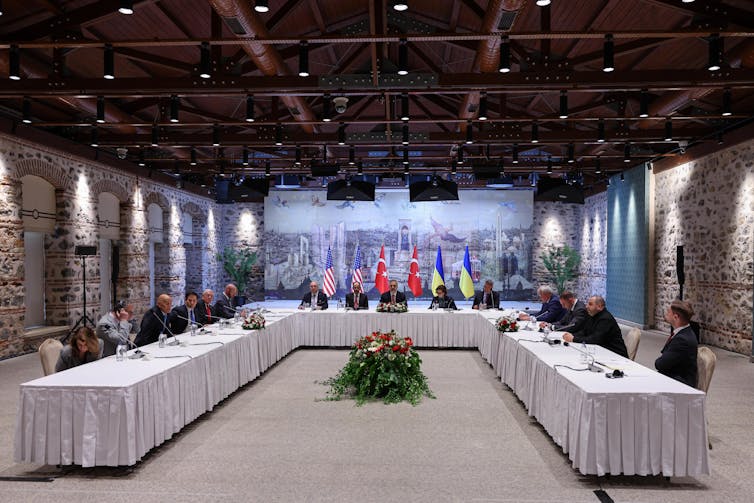
Converging blame
We found that in Ukraine, but not in Belarus, geopolitical views were sharply unified by the experience of the invasion. On one level, this is not surprising – after all, the people of a country being invaded would be expected to hold some degree of resentment to the invading army.
But what we found most interesting is that this effect in Ukraine massively overrode the split among various identities before the invasion. This was most prominent in people’s perceptions of who was to blame for rising tensions.
Prior to the invasion, 69.7% of respondents in Ukraine overall blamed Russia for the tensions between the two countries, with 30.3% blaming NATO, Ukraine or the U.S. By August 2022, 97.3% of respondents in Ukraine blamed Russia for the tensions, with only 2.7% blaming NATO, Ukraine or the U.S.
By comparison, in the neighboring country of Belarus, 15.5% of respondents blamed Russia for the tensions prior to the invasion, and only 21.9% of respondents blamed Russia for the tensions after the invasion.
This near unanimity in Ukraine masks the massive shifts you see when broken down for demographic differences. For example, blame varied widely across regions of Ukraine before the invasion but converged after the invasion. Prior to the invasion, only 36.0% of respondents in the east of Ukraine and 51.4% of respondents in the south of Ukraine blamed Russia for the tensions. After the invasion, over 96% of respondents in both regions blamed Russia.
A similar effect can be seen across other demographic differences. Only 30.6% of Catholics in Ukraine blamed Russia for the tensions prior to the invasion, while 83.0% blamed Russia later on.
What were once stratified opinions before the invasion became uniform afterward.
To check that this trend was not just an immediate post-invasion blip, we conducted the surveys again in September 2024 and February 2025. The overall proportion of Ukrainians who blamed Russia for the tensions remained high, with 85.7% and 84.5%, respectively. And again, these results held across the various demographic breakdowns.
In February 2025, the most recent survey, 77.2% of respondents in the east of Ukraine and 83.0% of respondents in the south blamed Russia. Catholics across Ukraine continued to blame Russia, with 90.7% in September 2024 and 90.6% in February 2025. Overall, there has been a small drop in the percentages of those blaming Russia – with war fatigue a possible reason.
Consequences for peace
Our findings suggest that in times of collective threat, divisions within a society tend to fade as people come together to face a common enemy.
And that could have huge consequences now, as various parties, including the U.S., look at peace proposals to end the Russia-Ukraine war. Among the options being explored is a scenario in which the current front lines are frozen.
This would entail recognizing the Russian-occupied territory of Crimea and the separatist regions of Donetsk and Luhansk as part of Russia. But it would also effectively relinquish Ukraine’s southeastern provinces of Kherson and Zaporizhzhia to Russia.
While our surveys cannot speak to how this will go down among the people of Crimea, Donetsk and Luhansk, the study did include Kherson and Zaporizhzhia. And our findings show that the sense of Ukrainian identity strengthened even among Russian-speaking people in those areas.
Ben Horne, Assistant Professor in the School of Information Sciences, University of Tennessee; Catherine Luther, Professor of Journalism & Media, University of Tennessee, and R. Alexander Bentley, Professor of Anthropology, University of Tennessee
This article is republished from The Conversation under a Creative Commons license. Read the original article.

The Conversation: ‘COVID modelling reveals new insights into ancient social distancing – podcast’
Five years since COVID emerged, not only has the pandemic affected the way we live and work, it’s also influencing the way researchers are thinking about the past.
In this episode of The Conversation Weekly podcast, archaeologist Alex Bentley explains how the pandemic has sparked new research into how disease may have affected ancient civilisations, and the clues this offers about a change in the way humans designed their villages and cities 8,000 years ago.
As an anthropologist and archaeologist at the University of Tennessee, Alex Bentley usually spend his time studying neolithic farming villages. But in the early days of the pandemic, he decided to team up with an epidemiologist on a research project to model the feedback loops between social behaviour, such as wearing a mask or not and the spread of disease. He says:
In doing that project, we learned so much about the spread of disease and its interaction with different behaviours. It was a perfect setup for looking at the same kind of question in the distant past when diseases were evolving for the first time in dense settlements.
Bentley was particularly interested in whether it could shed light on a conundrum: a curious pattern from the archaeological record that showed that early European farmers lived in large dense villages, then dispersed for centuries, then later formed cities again, which they also abandoned.
All this was happening in the neolithic period, between around 9000BC and 3000BC, a time when humans shifted from a nomadic hunterer-gatherer lifestyle to settling in small tribes in one place, cultivating the land and domesticating animals.
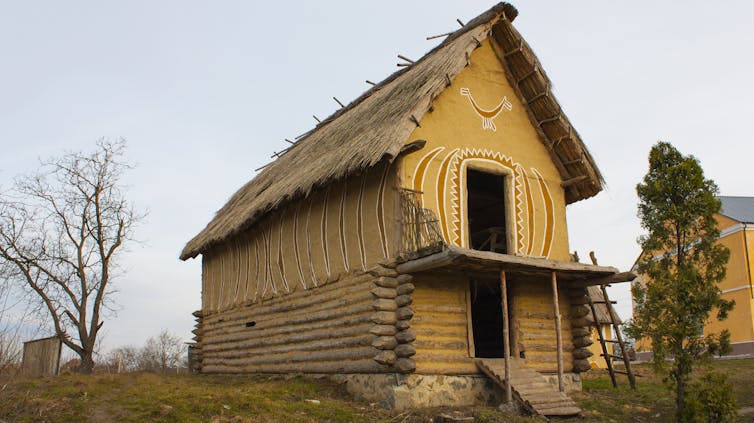
Bentley decided to apply the same model of how disease and patterns of behaviour spread during COVID, to map out how a contagious disease could have spread in an mega settlement called Nebelivka in modern-day Ukraine. This settlement was designed in an oval layout and divided into neighbourhoods, or clusters. Bentley and his colleagues suggest this layout, whether the inhabitants knew it or not, could have helped prevent the spread of disease.
Listen to the full episode of The Conversation Weekly to hear the interview with Alex Bentley.
This episode of The Conversation Weekly was written and produced by Katie Flood and hosted by Gemma Ware. Sound design was by Eloise Stevens and theme music by Neeta Sarl.
Newsclips in this episode from ABC News.
Listen to The Conversation Weekly via any of the apps listed above, download it directly via our RSS feed or find out how else to listen here.
Gemma Ware, Host, The Conversation Weekly Podcast, The Conversation
This article is republished from The Conversation under a Creative Commons license. Read the original article.


Kelsey Wahler, undergraduate in Anthropology, awarded Volunteer of Distinction Award
.
Congratulations to Kelsey Wahler, undergraduate in Anthropology, for being awarded the Volunteer of Distinction Award for Excellence in Research 2025!
.
Ms. Wahler worked with Lou Smith (M.D.) and other professionals at the University of Tennessee’s Medical Center studying the efficacy of intravenous lidocaine in patients with traumatic rib fractures, and she found the group who received intravenous lidocaine had significant reduction in pain scores, shorter hospital stays, and lower costs of treatment. This study, Intravenous Lidocaine for Rib Fractures: Effect on Pain Control and Outcome, was published in November of 2021 in The American Surgeon. In the midst of a national opioid epidemic, finding non-addictive pain management strategies for those with serious injuries is both a necessary and urgent matter. As an undergraduate student in Anthropology, Ms. Wahler has demonstrated excellence in research through peer-reviewed publication as she plans to apply to graduate programs, and we look forward to seeing the impact of her future works.
.
Kelsey Wahler was nominated by Dr. Kathleen Hauther, Department of Anthropology

Anthropology Master’s Program Ranked in Top 10
Anthropology Master’s Program Ranked in Top 10

The master’s degree program in anthropology at the University of Tennessee, Knoxville, has been named one of the top 10 in the country by College Factual.
The website ranked colleges and universities based on multiple factors, including educational resources, the caliber of the students, graduation rate, and even average salaries of graduates early in their careers.
“This ranking confirms what we already know: Our anthropology graduate program is among the very best in the discipline,” said Patrick Grzanka, division dean for social sciences in the UT College of Arts and Sciences. “Our exceptional faculty provide world-class training to our outstanding students, who are charting the future of anthropology.”
The Department of Anthropology holds an open house every October for prospective students to meet faculty and staff, speak with graduate students, and tour the state-of-the-art laboratories.
The Master of Arts program offers concentrations in anthropological archaeology, Mediterranean archaeology, biological anthropology, and cultural anthropology.
By Amy Beth Miller
Dr. Bentley’s Research Details Ancient Social Distancing
Socially distanced layout of the world’s oldest cities helped early civilization evade diseases

In my research focused on early farmers of Europe, I have often wondered about a curious pattern through time: Farmers lived in large dense villages, then dispersed for centuries, then later formed cities again, only to abandon those as well. Why?
Archaeologists often explain what we call urban collapse in terms of climate change, overpopulation, social pressures or some combination of these. Each likely has been true at different points in time.
But scientists have added a new hypothesis to the mix: disease. Living closely with animals led to zoonotic diseases that came to also infect humans. Outbreaks could have led dense settlements to be abandoned, at least until later generations found a way to organize their settlement layout to be more resilient to disease. In a new study, my colleagues and I analyzed the intriguing layouts of later settlements to see how they might have interacted with disease transmission.


Earliest cities: Dense with people and animals
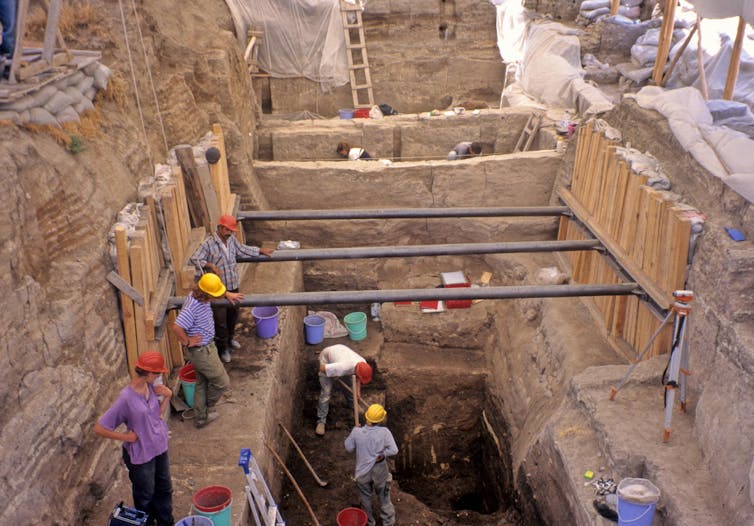
Çatalhöyük, in present-day Turkey, is the world’s oldest farming village, from over 9,000 years ago. Many thousands of people lived in mud-brick houses jammed so tightly together that residents entered via a ladder through a trapdoor on the roof. They even buried selected ancestors underneath the house floor. Despite plenty of space out there on the Anatolian Plateau, people packed in closely.

For centuries, people at Çatalhöyük herded sheep and cattle, cultivated barley and made cheese. Evocative paintings of bulls, dancing figures and a volcanic eruption suggest their folk traditions. They kept their well-organized houses tidy, sweeping floors and maintaining storage bins near the kitchen, located under the trapdoor to allow oven smoke to escape. Keeping clean meant they even replastered their interior house walls several times a year.
These rich traditions ended by 6000 BCE, when Çatalhöyük was mysteriously abandoned. The population dispersed into smaller settlements out in the surrounding flood plain and beyond. Other large farming populations of the region had also dispersed, and nomadic livestock herding became more widespread. For those populations that persisted, the mud-brick houses were now separate, in contrast with the agglomerated houses of Çatalhöyük.
Was disease a factor in the abandonment of dense settlements by 6000 BCE?
At Çatalhöyük, archaeologists have found human bones intermingled with cattle bones in burials and refuse heaps. Crowding of people and animals likely bred zoonotic diseases at Çatalhöyük. Ancient DNA identifies tuberculosis from cattle in the region as far back as 8500 BCE and TB in human infant bones not long after. DNA in ancient human remains dates salmonella to as early as 4500 BCE. Assuming the contagiousness and virulence of Neolithic diseases increased through time, dense settlements such as Çatalhöyük may have reached a tipping point where the effects of disease outweighed the benefits of living closely together.
A new layout 2,000 years later
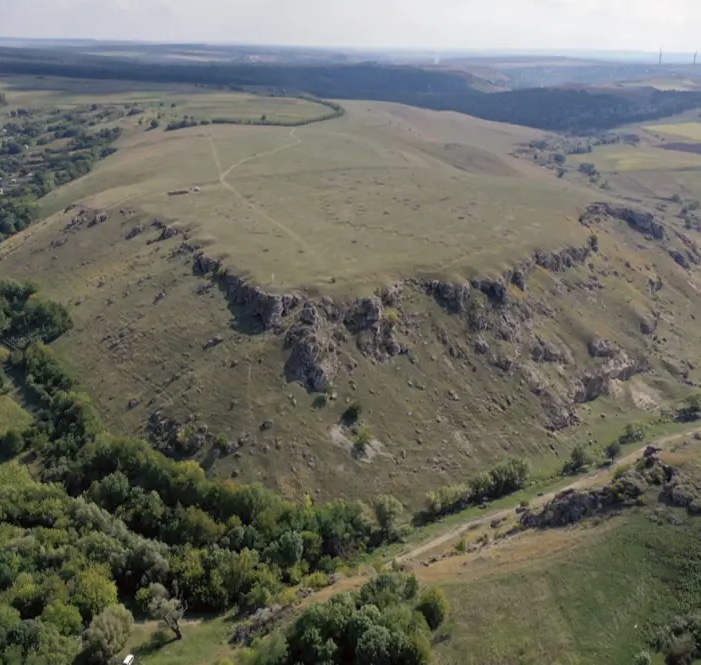
By about 4000 BCE, large urban populations had reappeared, at the mega-settlements of the ancient Trypillia culture, west of the Black Sea. Thousands of people lived at Trypillia mega-settlements such as Nebelivka and Maidanetske in what’s now Ukraine.
If disease was a factor in dispersal millennia before, how were these mega-settlements possible?

This time, the layout was different than at jam-packed Çatalhöyük: The hundreds of wooden, two-story houses were regularly spaced in concentric ovals. They were also clustered in pie-shaped neighborhoods, each with its own large assembly house. The pottery excavated in the neighborhood assembly houses has many different compositions, suggesting these pots were brought there by different families coming together to share food.
This layout suggests a theory. Whether the people of Nebelivka knew it or not, this lower-density, clustered layout could have helped prevent any disease outbreaks from consuming the entire settlement.
Archaeologist Simon Carrignon and I set out to test this possibility by adapting computer models from a previous epidemiology project that modeled how social-distancing behaviors affect the spread of pandemics. To study how a Trypillian settlement layout would disrupt disease spread, we teamed up with cultural evolution scholar Mike O’Brien and with the archaeologists of Nebelivka: John Chapman, Bisserka Gaydarska and Brian Buchanan.
Simulating socially distanced neighborhoods
To simulate disease spread at Nebelivka, we had to make a few assumptions. First, we assumed that early diseases were spread through foods, such as milk or meat. Second, we assumed people visited other houses within their neighborhood more often than those outside of it.
Would this neighborhood clustering be enough to suppress disease outbreaks? To test the effects of different possible rates of interaction, we ran millions of simulations, first on a network to represent clustered neighborhoods. We then ran the simulations again, this time on a virtual layout modeled after actual site plans, where houses in each neighborhood were given a higher chance of making contact with each other.

Based on our simulations, we found that if people visited other neighborhoods infrequently – like a fifth to a tenth as often as visiting other houses within their own neighborhood – then the clustering layout of houses at Nebelivka would have significantly reduced outbreaks of early foodborne diseases. This is reasonable given that each neighborhood had its own assembly house. Overall, the results show how the Trypillian layout could help early farmers live together in low-density urban populations, at a time when zoonotic diseases were increasing.
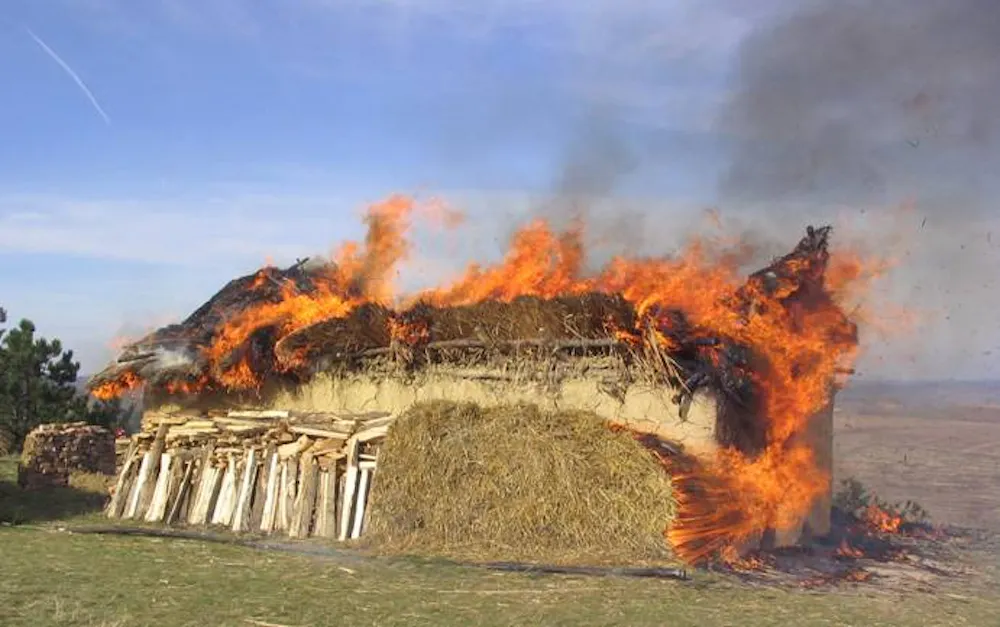
The residents of Nebilevka didn’t need to have consciously planned for their neighborhood layout to help their population survive. But they may well have, as human instinct is to avoid signs of contagious disease. Like at Çatalhöyük, residents kept their houses clean. And about two-thirds of the houses at Nebelivka were deliberately burned at different times. These intentional periodic burns may have been a pest extermination tactic.

New cities and innovations
Some of the early diseases eventually evolved to spread by means other than bad foods. Tuberculosis, for instance, became airborne at some point. When the bacterium that causes plague, Yersinia pestis, became adapted to fleas, it could be spread by rats, which would not care about neighborhood boundaries.
Were new disease vectors too much for these ancient cities? The mega-settlements of Trypillia were abandoned by 3000 BCE. As at Çatalhöyük thousands of years before, people dispersed into smaller settlements. Some geneticists speculate that Trypillia settlements were abandoned due to the origins of plague in the region, about 5,000 years ago.
The first cities in Mesopotamia developed around 3500 BCE, with others soon developing in Egypt, the Indus Valley and China. These cities of tens of thousands were filled with specialized craftspeople in distinct neighborhoods.
This time around, people in the city centers weren’t living cheek by jowl with cattle or sheep. Cities were the centers of regional trade. Food was imported into the city and stored in large grain silos like the one at the Hittite capital of Hattusa, which could hold enough cereal grain to feed 20,000 people for a year. Sanitation was helped by public water works, such as canals in Uruk or water wells and a large public bath at the Indus city of Mohenjo Daro.
These early cities, along with those in China, Africa and the Americas, were the foundations of civilization. Arguably, their form and function were shaped by millennia of diseases and human responses to them, all the way back to the world’s earliest farming villages.
R. Alexander Bentley, Professor of Anthropology, University of Tennessee
This article is republished from The Conversation under a Creative Commons license. Read the original article.
- « Previous Page
- 1
- 2
- 3
- 4
- …
- 7
- Next Page »